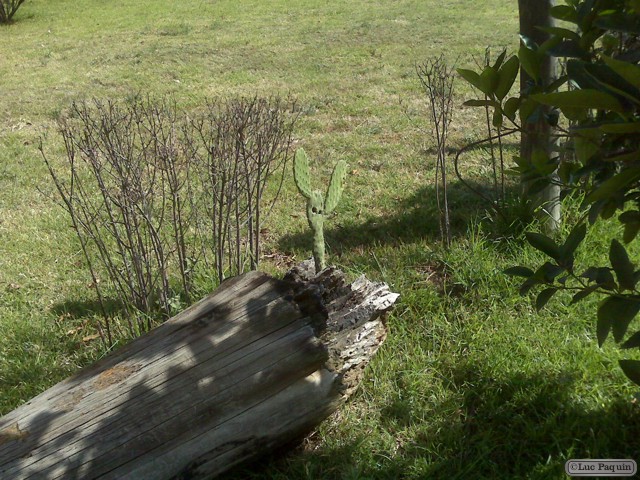
Cactus, Mexico, November 22, 2011

Cactus 5 Mk01

Year: 2011 (November 22, 2011)

11″ x 8.5″

Media: Canon® Pro Platinum High Gloss Photo Paper

Printers: Canon® PIXMA

Color

Art: Photo

Artist: Luc Paquin

Citlalin, Acozac, Mexico

Cactus

A cactus is a member of the plant family Cactaceae within the order Caryophyllales. The word “cactus” derives, through Latin, from the Ancient Greek, kaktos, a name originally used by Theophrastus for a spiny plant whose identity is not certain. Cacti occur in a wide range of shapes and sizes. Most cacti live in habitats subject to at least some drought. Many live in extremely dry environments, even being found in the Atacama Desert, one of the driest places on earth. Cacti show many adaptations to conserve water. Almost all cacti are succulents. Unlike many other succulents, the stem is the only part of most cacti where this vital process takes place. Cactus stems store water. Most species of cacti have lost true leaves, retaining only spines, which are highly modified leaves. As well as defending against herbivores, spines help prevent water loss by reducing air flow close to the cactus and providing some shade. In the absence of leaves, enlarged stems carry out photosynthesis. Cacti are native to the Americas, ranging from Patagonia in the south to parts of western Canada in the north; except for Rhipsalis baccifera, which also grows in Africa and Sri Lanka.

Luc
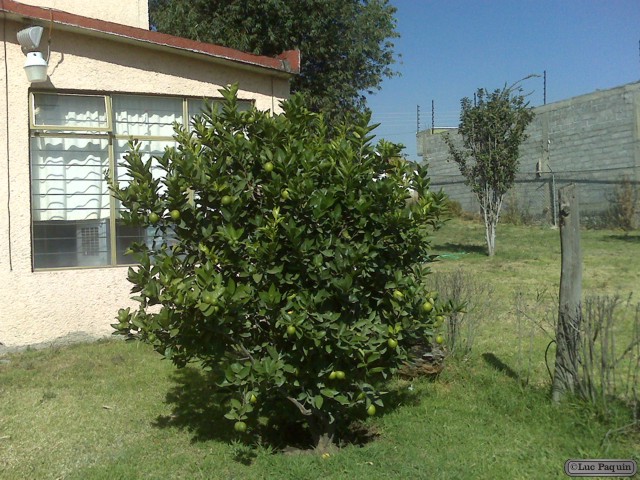
Lime, Mexico, November 22, 2011

Lime 5 Mk01

Year: 2011 (November 22, 2011)

11″ x 8.5″

Media: Canon® Pro Platinum High Gloss Photo Paper

Printers: Canon® PIXMA

Color

Art: Photo

Artist: Luc Paquin

Citlalin, Acozac, Mexico

Lime

A lime (from Arabic and French lim)[1] is a citrus fruit, which is typically round, lime green, 3-6 centimetres in diameter, and containing sour (acidic) pulp. There are several species of citrus trees whose fruits are called limes, including the Key lime (Citrus aurantifolia), Persian lime, kaffir lime, and desert lime. Limes are an excellent source of vitamin C, and are often used to accent the flavours of foods and beverages. They are grown year-round in tropical climates and are usually smaller and less sour than lemons, although varieties may differ in sugar and acidic content. Plants with fruit called “limes” have diverse genetic origins; “Limes” is not a monophyletic group.

Luc

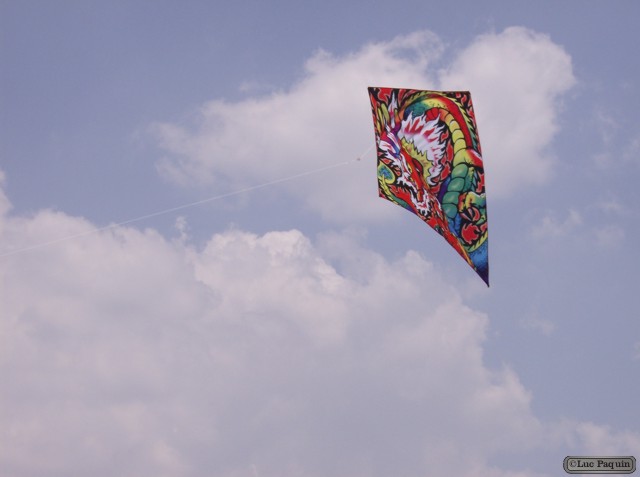
Papalote, Mexico, August 23, 2009

Papalote 5 Mk01

Year: 2009 (August 23, 2009)

11″ x 8.5″

Media: Canon® Pro Platinum High Gloss Photo Paper

Printers: Canon® PIXMA

Color

Art: Photo

Artist: Luc Paquin

Citlalin, Acozac, Mexico

Papalote (Kite)

A kite is a tethered object with an aerodynamic surface that creates lift in order to overcome gravity and fly. Kites have a long and varied history and there are many types of kites that are flown individually and at festivals world wide.

The necessary lift that sustains the kite in flight is generated when air flows above the kite’s surface, producing low pressure above and high pressure below the wings. The interaction with the wind also generates horizontal drag along the direction of the wind. The resultant force vector from the lift and drag force components is opposed by the tension of one or more of the lines or tethers to which the kite is attached.

Luc

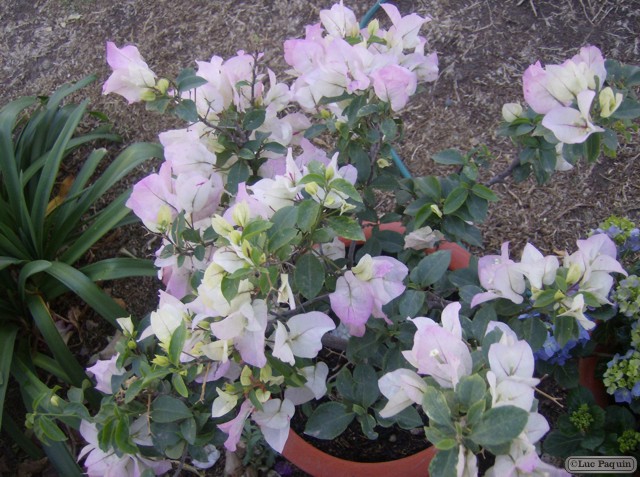
Bugambilia, Mexico, April 23, 2012

Bugambilia 5 Mk01

Year: 2012 (April 23, 2012)

11″ x 8.5″

Media: Canon® Pro Platinum High Gloss Photo Paper

Printers: Canon® PIXMA

Color

Art: Photo

Artist: Luc Paquin

Citlalin, Acozac, Mexico

Bugambilia

Bougainvillea is a genus of thorny ornamental vines, bushes, and trees with flower-like spring leaves near its flowers. Different authors accept between four and 18 species in the genus. They are native plants of South America from Brazil west to Perú and south to southern Argentina (Chubut Province). Bougainvillea are also known as buganvilla (Spain), bugambilia (Mexico), Napoleón (Honduras), veranera (Colombia, Nicaragua, El Salvador, Costa Rica and Panama), trinitaria (Colombia, Cuba, Panama, Puerto Rico, Dominican Republic & Venezuela), Santa Rita (Argentina, Bolivia, Brazil, Paraguay and Uruguay) or papelillo (northern Peru).

The vine species grow anywhere from 1 to 12 m tall, scrambling over other plants with their spiky thorns. The thorns are tipped with a black, waxy substance. They are evergreen where rainfall occurs all year, or deciduous if there is a dry season. The leaves are alternate, simple ovate-acuminate, 4-13 cm long and 2-6 cm broad. The actual flower of the plant is small and generally white, but each cluster of three flowers is surrounded by three or six bracts with the bright colours associated with the plant, including pink, magenta, purple, red, orange, white, or yellow. Bougainvillea glabra is sometimes referred to as “paper flower” because the bracts are thin and papery. The fruit is a narrow five-lobed achene.

Luc

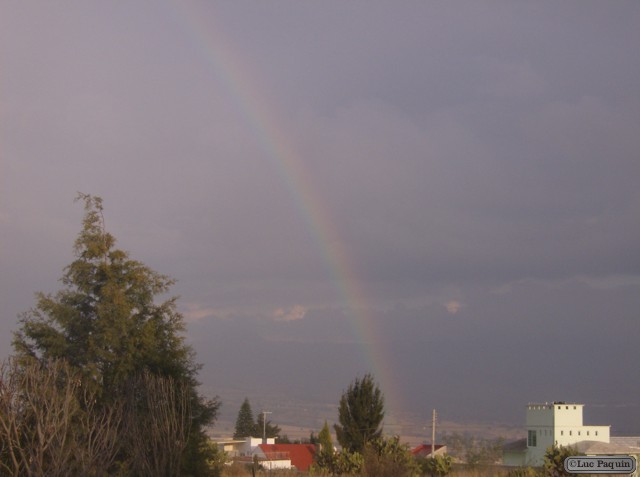
Arcoiris, Mexico, February 10, 2010

Arcoiris 5 Mk01

Year: 2010 (February 10, 2010)

11″ x 8.5″

Media: Canon® Pro Platinum High Gloss Photo Paper

Printers: Canon® PIXMA

Color

Art: Photo

Artist: Luc Paquin

Citlalin, Acozac, Mexico

Arcoiris (Rainbow)

A rainbow is an optical and meteorological phenomenon that is caused by reflection, refraction and dispersion of light in water droplets resulting in a spectrum of light appearing in the sky. It takes the form of a multicoloured arc. Rainbows caused by sunlight always appear in the section of sky directly opposite the sun.

In a primary rainbow, the arc shows red on the outer part and violet on the inner side. This rainbow is caused by light being refracted (bent) when entering a droplet of water, then reflected inside on the back of the droplet and refracted again when leaving it.

Luc

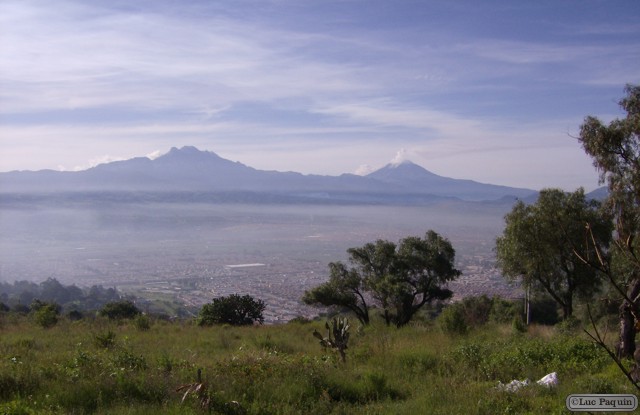
Acozac, Mexico, July 17, 2007

Popocatepet lIztaccihuatl 5 Mk01

Year: 2007 (July 17, 2007)

11″ x 8.5″

Media: Canon® Pro Platinum High Gloss Photo Paper

Printers: Canon® PIXMA

Color

Art: Photo

Artist: Luc Paquin

Mixcotl, Acozac, Mexico

Popocatépetl and Iztaccíhuatl

Iztaccíhuatl’s father sent Popocatepetl to war in Oaxaca, promising him his daughter as his wife if he returned. Iztaccíhuatl’s father presumed he would not return and so arranged several suitors for his daughter. When Iztaccíhuatl heard of this she killed herself with a dagger, because she knew that Popocatepetl would never survive in battle, and did not want to marry anyone else. When Popocatépetl returned, and discovered the death of his lover, he took her to the top of the mountain, hoping the cold would wake her but Instead he froze. God covered them with snow and changed them into mountains. Iztaccíhuatl’s mountain was called “La Mujer Dormida, (the “Sleeping Woman”), because it bears a resemblance to a woman sleeping on her back. Popocatépetl became the volcano Popocatépetl, raining fire on Earth in blind rage at the loss of his beloved.

Luc

Dragones Enamorados, Oceanside, July 2013

Dragones Enamorados Mk5

Year: 2013 (July 2013)

20″ (L) x 16″ (H)

Painting media: Acrylic paint

Art: Canvas

Artist: Norma Carreño

Dragones Enamorados

Norma Carreño painting of July 2013.

Painting

Painting is the practice of applying paint, pigment, color or other medium to a surface (support base). The medium is commonly applied to the base with a brush but other implements, such as knives, sponges, and airbrushes, can be used.

In art, the term painting describes both the act and the result of the action. Paintings may have for their support such surfaces as walls, paper, canvas, wood, glass, lacquer, clay, leaf, copper or concrete, and may incorporate multiple other materials including sand, clay, paper, plaster, gold leaf as well as objects.

Luc

Taxco, Mexico, November 2003

Taxco 5 Mk02

Year: 2003 (November 2003)

11″ x 8.5″

Media: Canon® Pro Platinum High Gloss Photo Paper

Printers: Canon® PIXMA

Color

Art: Photo

Artist: Luc Paquin

Taxco, Mexico

Silver and Silversmithing

Silverwork and tourism related to Taxco’s status as a silver town is the mainstay of the economy. There is one major mining operation on the outskirts of town, Industrial Minera México S.A., but this enterprise announced in 2007 that it will phase out operations here due to the depletion of reserves and labor problems. Most commercial activity related to silver is the production and sale of silver jewelry, silverware and other goods. Silversmithing was reinvigorated here by American William Spratling, who moved to Taxco in the 1920s, creating silver design workshops and exported items, mostly to the United States. With its fame for silversmithing, tourism became a major economic force for the town. Commerce in silver here is both regional and international. Just under half of the municipality’s population is involved in the tourism trade. Streets in the town are filled with silvershops selling jewelry, silverware and other goods.

Luc

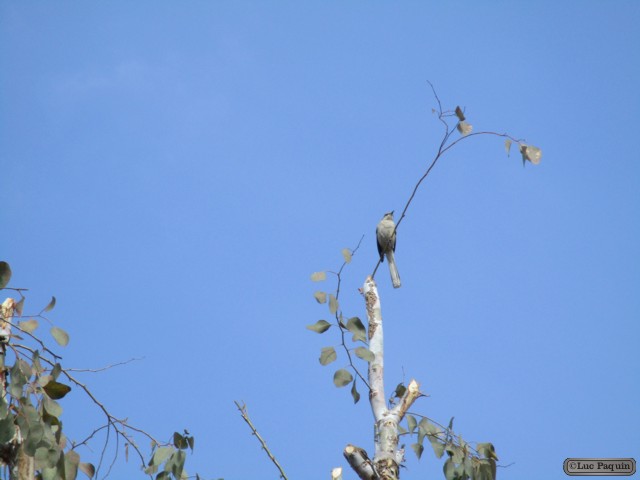
Rocking Horse Ln, Oceanside, May 13, 2015

Bewick Wren 5 Mk01

Year: 2015 (May 13, 2015)

11″ x 8.5″

Media: Canon® Pro Platinum High Gloss Photo Paper

Printers: Canon® PIXMA

Color

Art: Photo

Artist: Luc Paquin

Rocking Horse Ln

Bewick’s Wren

The Bewick’s wren (Thryomanes bewickii) is a wren native to North America. At about 14 cm long, it is grey-brown above, white below, with a long white eyebrow. While similar in appearance to the Carolina wren, it has a long tail that is tipped in white. The song is loud and melodious, much like the song of other wrens. The song is broken into two or three individual parts; one individual male may exhibit up to twenty-two different variations on the song pattern, and may even throw in a little ventriloquism to vary it even further. It lives in thickets, brush piles and hedgerows, open woodlands and scrubby areas, often near streams. It eats insects and spiders, which it gleans from vegetation or finds on the ground. Wrens are sometimes observed foraging with chickadees and other birds.

Luc

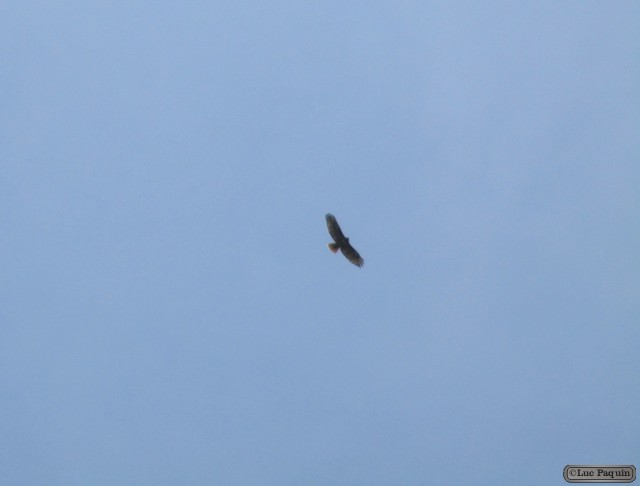
Vista Community Clinic, May 11, 2015

Eagle Mk01

Year: 2015 (May 11, 2015)

11″ x 8.5″

Media: Canon® Pro Platinum High Gloss Photo Paper

Printers: Canon® PIXMA

Color

Art: Photo

Artist: Luc Paquin

Vista Community Clinic

Eagle

Eagle is a common name for many large birds of prey of the family Accipitridae; it belongs to several groups of genera that are not necessarily closely related to each other.

Most of the sixty species of eagles are from Eurasia and Africa. Outside this area, just fourteen species can be found – two in North America, nine in Central and South America, and three in Australia.

Luc