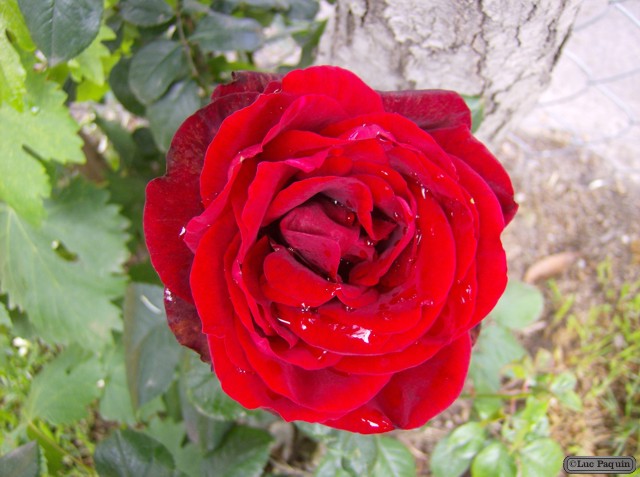
Acozac, Mexico, April 28, 2008

Rose 5 Mk01

Year: 2008 (April 28, 2008)

11″ x 8.5″

Media: Canon® Pro Platinum High Gloss Photo Paper

Printers: Canon® PIXMA

Color

Art: Photo

Artist: Luc Paquin

Citlalin, Acozac, Mexico

Rose

A rose is a woody perennial of the genus Rosa, within the family Rosaceae. There are over 100 species and thousands of cultivars. They form a group of plants that can be erect shrubs, climbing or trailing with stems that are often armed with sharp prickles. Flowers vary in size and shape and are usually large and showy, in colours ranging from white through yellows and reds. Most species are native to Asia, with smaller numbers native to Europe, North America, and northwest Africa. Species, cultivars and hybrids are all widely grown for their beauty and often are fragrant. Rose plants range in size from compact, miniature roses, to climbers that can reach seven meters in height. Different species hybridize easily, and this has been used in the development of the wide range of garden roses.

Luc

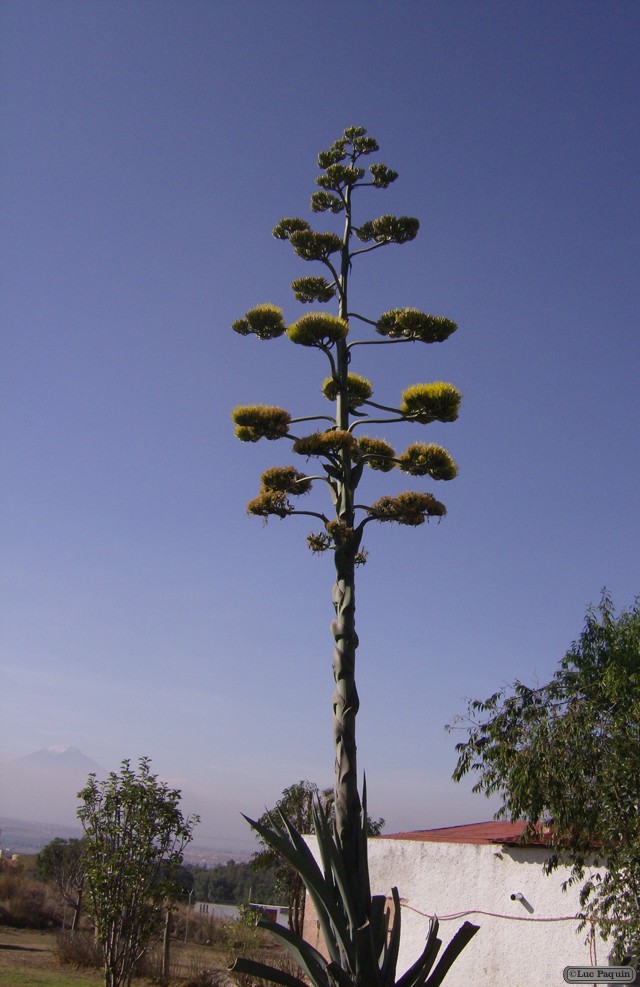
Acozac, Mexico, April 28, 2008

Agave 5 Mk01

Year: 2008 (April 28, 2008)

8.5″ x 11″

Media: Canon® Pro Platinum High Gloss Photo Paper

Printers: Canon® PIXMA

Color

Art: Photo

Artist: Luc Paquin

Citlalin, Acozac, Mexico

Agave

Agave is a genus of monocots. The plants are perennial, but each rosette flowers once and then dies (see semelparity). Some species are known by the name century plant.

In the APG III system, the genus is placed in the subfamily Agavoideae of the broadly circumscribed family Asparagaceae. Some authors prefer to place it in the segregate family Agavaceae. Traditionally, it was circumscribed to be composed of about 166 species, but it is now usually understood to have about 208 species.

Luc

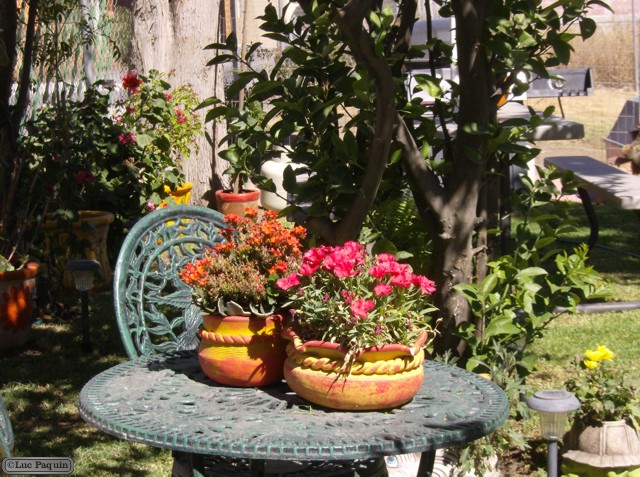
Acozac, Mexico, December 23, 2008

Acozac 5 Mk01

Year: 2008 (December 23, 2008)

11″ x 8.5″

Media: Canon® Pro Platinum High Gloss Photo Paper

Printers: Canon® PIXMA

Color

Art: Photo

Artist: Luc Paquin

Citlalin, Acozac, Mexico

Acozac

Acozac is a community that belongs to the municipality of Tecámac in the State of Mexico in Mexico. It has a population of 20,478 inhabitants and is located at an altitude of 2,250 meters above sea level. The area is known for significant deposits of mammoth bones.

Luc

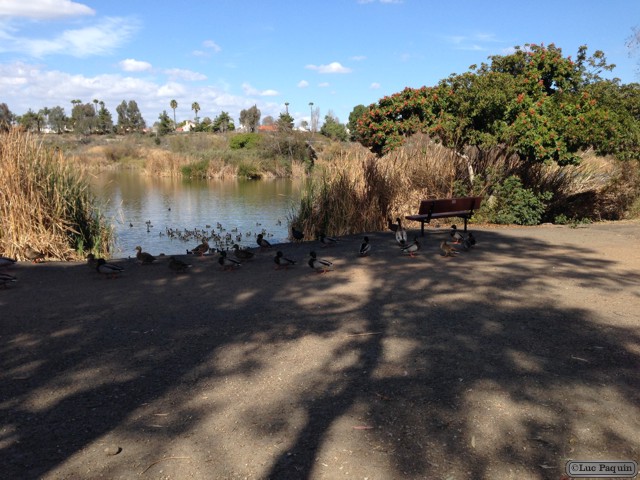
Guajome Regional Park, Oceanside, April 5, 2014

Guajome 5 Mk02

Year: 2014 (April 5, 2014)

11″ x 8.5″

Media: Canon® Pro Platinum High Gloss Photo Paper

Printers: Canon® PIXMA

Color

Art: Photo

Artist: Luc Paquin

Guajome Regional Park

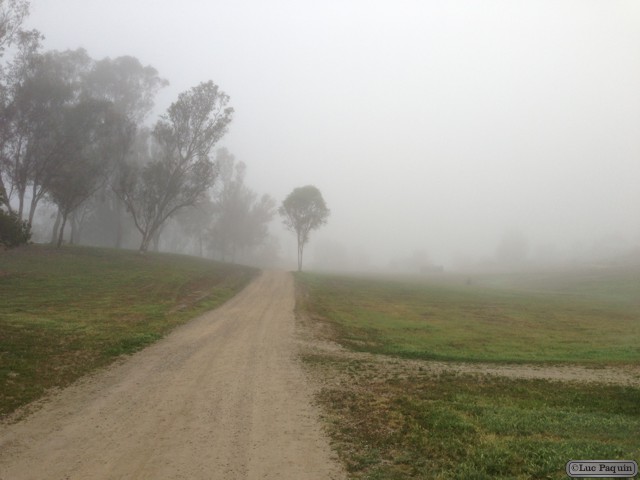
Two ponds attract a wide variety of migratory birds and serve as home to a variety of fish that will test the skills of any angler. 4.5 miles of park trails meander through diverse Southern California habitats such as woodlands, chaparral, wetlands, and mixed grasslands.

Duck

Duck is the common name for a large number of species in the Anatidae family of birds which also includes swans and geese. The ducks are divided among several subfamilies in the Anatidae family; they do not represent a monophyletic group (the group of all descendants of a single common ancestral species) but a form taxon, since swans and geese are not considered ducks. Ducks are mostly aquatic birds, mostly smaller than the swans and geese, and may be found in both fresh water and sea water.

Luc

Oceanside, California, January 10, 2015

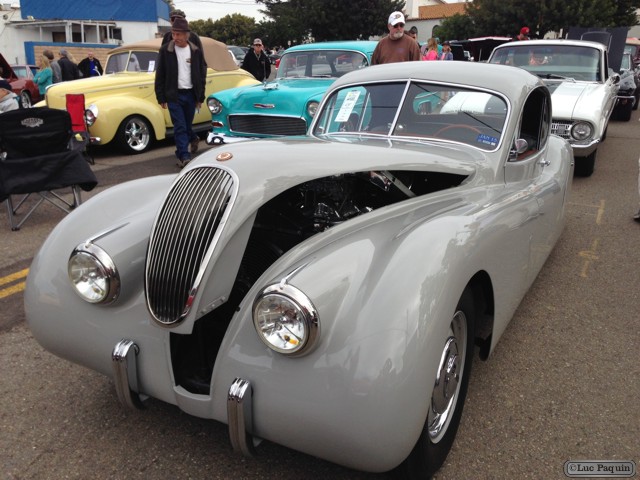
Jaguar XK120 5 Mk03

Year: 2015 (January 10, 2015)

11″ x 8.5″

Media: Canon® Pro Platinum High Gloss Photo Paper

Printers: Canon® PIXMA

Color

Art: Photo

Artist: Luc Paquin

Danny’s Donuts, Vista, CA

California Car Shows

United Kingdom

There is no fixed definition of a classic car. Two taxation issues do impact however, leading to some people using them as cutoff dates. All cars built before January 1, 1973, are exempted from paying the annual road tax vehicle excise duty. This is then entered on the licence disc displayed on the windscreen as “historic vehicle” (if a car built before this date has been first registered in 1973 or later, then its build date would have to be verified by a recognised body such as British Motor Heritage Foundation to claim tax-free status). HM Revenue and Customs define a classic car for company taxation purposes as being over 15 years old and having a value in excess of £15,000. Additionally, popular acclaim through a large number of classic car magazines plays an important role in whether a car comes to be regarded as a classic. It is all subjective and a matter of opinion. The elimination of depreciation is a reason for buying a classic car; this is a major cost of owning a modern car. Picking ‘future classics’ that are current ‘bangers’ is a pastime of people into classic cars in the UK. Successfully picking and buying one can result in a profit for the buyer as well as providing transport. An immaculate well cared for prestige model with high running costs that impacts its value, but is not yet old enough to be regarded as a classic, could be a good buy, for example. A change in the taxation class is due to take force in April 2014, by moving the cut-off date of the historic vehicle class from January 1973 to January 1974, thus including all cars registered and built in 1973 as historic

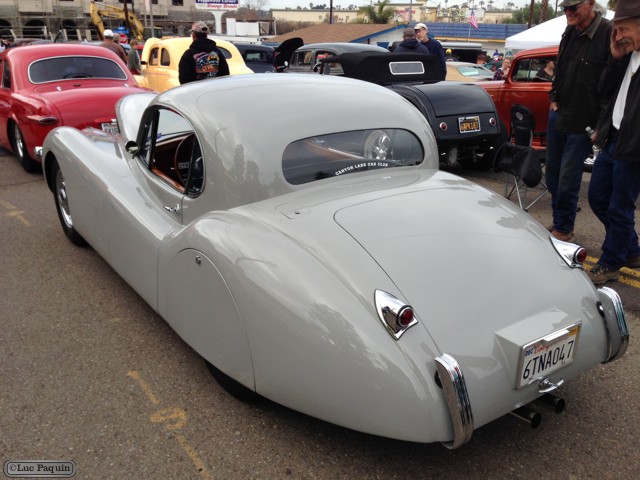
Jaguar XK120

The XK120 was ultimately available in two open versions, first as an open 2-seater described in the US market as the roadster (and designated OTS, for open two-seater, in America), then also as a drophead coupé (DHC) from 1953; and also as a closed, or fixed head coupé (FHC) from 1951.

A smaller-engined version 2-litres, 4 cylinders, intended for the UK market was cancelled prior to production.

On 30 May 1949, on the empty Ostend-Jabbeke motorway in Belgium, a prototype XK120 timed by the officials of the Royal Automobile Club of Belgium achieved an average of runs in opposing directions of 132.6 mph with the windscreen replaced by just one small aeroscreen and a catalogued alternative top gear ratio, and 135 mph with a passenger-side tonneau cover in place. In 1950 and 1951, at a banked oval track in France, XK120 roadsters averaged over 100 mph for 24 hours and over 130 mph for an hour, and in 1952 a fixed-head coupé took numerous world records for speed and distance when it averaged 100 mph for a week.

Roadsters were also successful in racing and rallying.

Luc

Guajome Regional Park, Oceanside, March 25, 2013

Guajome 5 Mk01

Year: 2013 (March 25, 2013)

11″ x 8.5″

Media: Canon® Pro Platinum High Gloss Photo Paper

Printers: Canon® PIXMA

Color

Art: Photo

Artist: Luc Paquin

Guajome Regional Park

Guajome Regional Park is located in the coastal community of Oceanside and has a little bit of everything that San Diego County offers. A developed 33-site campground offers partial hook ups, a caravan pavilion, shade and afternoon ocean breezes. Two day use areas with new playgrounds, a basketball court and lots of green lawn are ideal for picnicking or just relaxing.

Luc

Old Mission San Luis Rey, Oceanside, October 26, 2014

Old Mission San Luis Rey 5 Mk03

Year: 2014 (October 26, 2014)

8.5″ x 11″

Media: Canon® Pro Platinum High Gloss Photo Paper

Printers: Canon® PIXMA

Color

Art: Photo

Artist: Luc Paquin

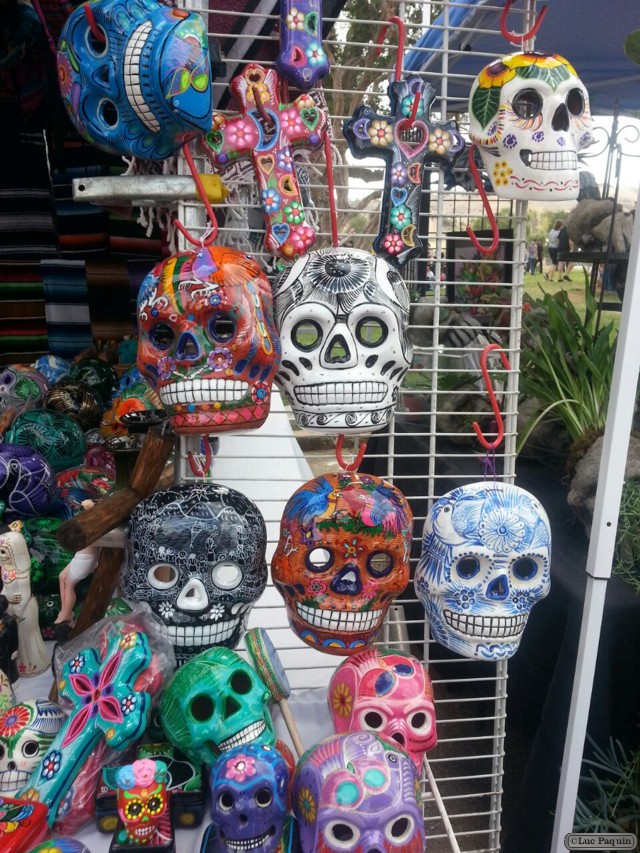
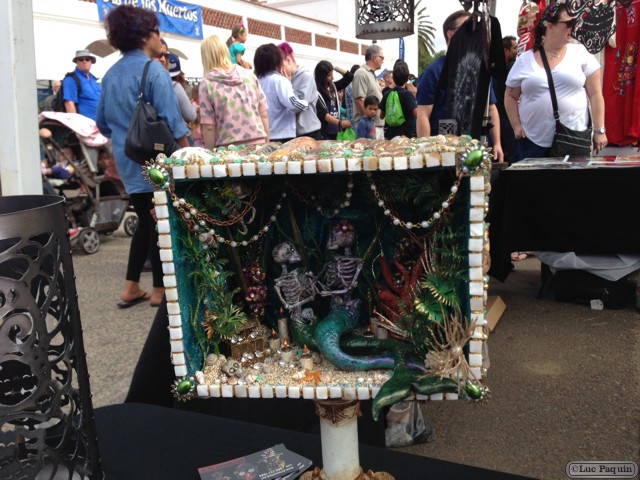
Dia de los Muertos – Day of the Dead

Old Mission San Luis Rey

Mission San Luis Rey de Francia is a former Spanish mission in the present-day city of Oceanside, California. The mission was founded on June 13, 1798 by Padre Fermín Lasuén, and was the eighteenth of the Spanish missions established in California. Named for Saint Louis, the mission lent its name to the Luiseño tribe of Mission Indians.

The current church, built in 1811, is the third church on this location. It is a National Historic Landmark, for its pristine example of a Spanish mission church complex. Today the mission complex functions as a parish church of the Diocese of San Diego as well as a museum and retreat center.

Luc

Old Mission San Luis Rey, Oceanside, October 26, 2014

Old Mission San Luis Rey 5 Mk02

Year: 2014 (October 26, 2014)

11″ x 8.5″

Media: Canon® Pro Platinum High Gloss Photo Paper

Printers: Canon® PIXMA

Color

Art: Photo

Artist: Luc Paquin

Dia de los Muertos – Day of the Dead

Old Mission San Luis Rey

Old Mission San Luis Rey’s museum’s collection includes artifacts from Native American, Spanish, Mission, Mexican Secularization and American Military periods. A tour of the Museum begins in the Founder’s Room with exhibits of the Luiseno Indian culture and traces the arrival of the Spanish Franciscan Missionaries in the early stages of the mission settlement.

Luc

Old Mission San Luis Rey, Oceanside, October 26, 2014

Old Mission San Luis Rey 5 Mk01

Year: 2014 (October 26, 2014)

11″ x 8.5″

Media: Canon® Pro Platinum High Gloss Photo Paper

Printers: Canon® PIXMA

Color

Art: Photo

Artist: Luc Paquin

Dia de los Muertos – Day of the Dead

Old Mission San Luis Rey

Founded in 1798 by Padre Fermin Francisco de Lasuen, the Mission was named after St. Louis IX, King of France, who lived during the 13th century. The history of the San Luis Rey area reflects five periods of occupation: Luiseno Indian, Spanish Mission, Mexican Secularization, American Military, and Twentieth Century Restoration. Because of its large size the mission has been nicknamed “King of the Missions.”

Luc

Oceanside, California, January 10, 2015

Jaguar XK120 5 Mk02

Year: 2015 (January 10, 2015)

11″ x 8.5″

Media: Canon® Pro Platinum High Gloss Photo Paper

Printers: Canon® PIXMA

Color

Art: Photo

Artist: Luc Paquin

Danny’s Donuts, Vista, CA

California Car Shows

United States legal definition

Legally, most states have time-based rules for the definition of “classic” for purposes such as antique vehicle registration; for example, Most states define it as “A motor vehicle, but not a reproduction thereof, manufactured at least 20 years prior to the current year which has been maintained in or restored to a condition which is substantially in conformity with manufacturer specifications and appearance.”

Despite this, at many American classic car shows, automobiles typically range from the thirties to sixties. Examples of cars at such shows include the Chevrolet Bel-Air, Ford T-Bucket, Dodge Charger, Chevrolet Deuce Coupe, and 1949 Ford. Meanwhile, the Concours D’Elegance car shows feature prestigious automobiles such as the Cadillac V16 or pre-1940 Rolls-Royce models. “Classic” cars at these shows seldom go beyond 1972. Any cars from 1973 onward are defined as “modern customs”, “exotics”, or “collectibles”. For interest, cars such as the AMC Gremlin or Ford Pinto may be exhibited.

Americans are divided on the exact era in which a “classic car” can be identified. Many Americans divide automobiles by separate eras: horseless carriages (19th century experimental automobiles such as the Daimler Motor Carriage), antique cars (brass era cars such as the Ford Model T), and classic cars (typically 1930s cars such as the Cord 812 through the end of the muscle car period in the 1970s – a majority use the 1972 model year as the cutoff). The late seventies are disputed as being “classics”, as the oil crisis of 1973 brought several now-infamous cars such as the Ford Pinto and AMC Gremlin. The 1980s are often viewed as the early modern period due to the rise of Japanese automakers such as Toyota and Nissan.

Jaguar XK120

The XK120 was launched in open two-seater or (US) roadster form at the 1948 London Motor Show as a testbed and show car for the new Jaguar XK engine. The display car was the first prototype, chassis number 670001. It looked almost identical to the production cars except that the straight outer pillars of its windscreen would be curved on the production version. The roadster caused a sensation, which persuaded Jaguar founder and design boss William Lyons to put it into production.

Beginning in 1948, the first 242 cars wore wood-framed open 2-seater bodies with aluminium panels. Production switched to the 1cwt or 51 kg heavier all-steel in early 1950. The “120” in the name referred to the aluminium car’s 193 km/h top speed (faster with the windscreen removed), which made it the world’s fastest production car at the time of its launch. In 1949 the first production roadster, chassis number 670003, was delivered to Clark Gable.

Luc